
FRAMEWORK MODULES FOR UNITY
Currency & Economy
Deterministic currency, fees, and economic flows built for real game logic
not hidden math.
What this bundle gives you
This bundle provides a deterministic foundation for handling currency, transactions, and economic rules in Unity projects.
Currency is treated as explicit state, with clear ownership, routing, and evaluation — not hidden arithmetic scattered across gameplay code.
Explicit currency and balance management
Clear control over balances, adjustments, transfers, and ownership.
Deterministic transaction flows
Every change to currency is routed through defined transactions — not ad-hoc math.
Composable economic rules
Fees, taxes, splits, modifiers, and routing handled as modular rules.
System-agnostic by design
No assumptions about shops, inventories, UI, or monetisation models.
Value moves through systems. Nothing happens “by accident”.
Included Systems
Currency System
Explicit currency state with clear ownership and predictable balance changes.
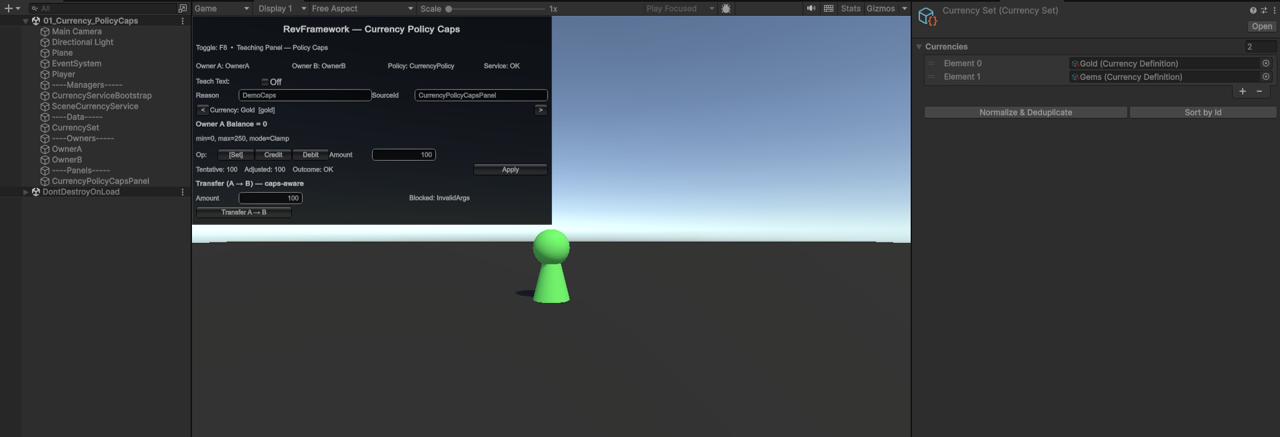
Currency balances managed through explicit ledgers with predictable state changes.
Explicit balances and ownership
Currency lives in defined ledgers with clear responsibility and scope.Multiple currencies supported
Handle soft, hard, premium, or abstract currencies without special cases.Deterministic adjustments
Increments, decrements, and transfers are explicit and inspectable.No UI or shop assumptions
Currency logic is independent of presentation or commerce flows.
Economy & Transactions
All currency movement routed through explicit, inspectable transactions.
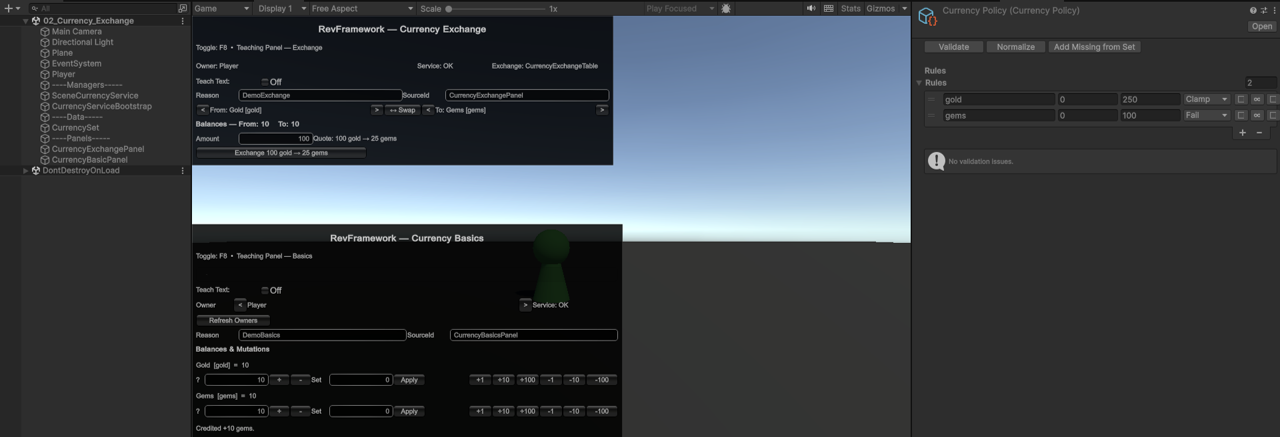
Currency routed through explicit transactions with clear intent and traceable outcomes.
Transaction-based currency flow
Every currency change is represented as a transaction, not inline math.Clear routing and intent
Source, destination, and reason are explicit for every operation.Composable transaction rules
Modify transactions safely without rewriting core logic.Audit-friendly by design
Transactions can be logged, traced, or replayed if required.
Fees, Splits & Economic Rules
Composable economic rules applied predictably to currency flow.
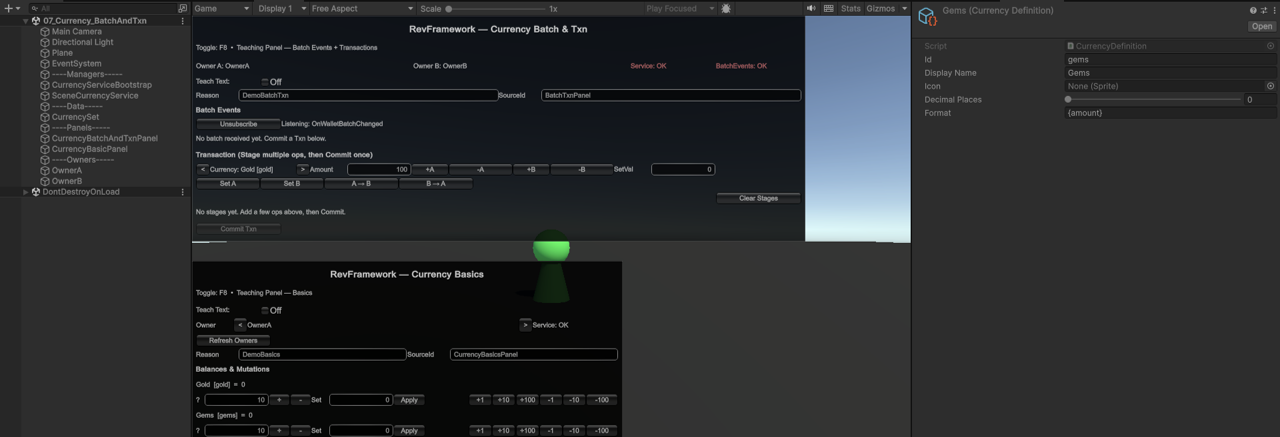
Economic rules applied predictably to transactions with explicit evaluation order.
Fees, taxes, and splits as rules
Economic modifiers are applied as modular rules, not special cases.Predictable evaluation order
Rule priority and execution order are explicit and inspectable.Optional by design
Use fees and routing only where needed — no global assumptions.Designed for extension
Add new economic behaviours without touching core systems.
Every core system in RevFramework ships with dedicated demo scenes and teachable panels. Each key feature is demonstrated live in-scene, with clear explanations of what’s happening, why it matters, and how the pieces fit together. Full written documentation is provided via MkDocs, but the systems are designed to be understood by using them — not by memorising APIs.
Rev
Architecture
RevFramework systems are built to be understandable, replaceable, and safe to extend.
Nothing relies on hidden state, implicit ordering, or editor-time magic.
- Interfaces first, concrete types last
Systems communicate through contracts, not hard references.
- Adapters, not assumptions
Inventory, Currency, Health, and other systems integrate via adapters — not direct dependencies.
- Optional dependencies by design
Remove a system and the rest of the project still compiles and runs cleanly.
- Deterministic, inspectable logic
State changes are explicit, ordered, and visible — no background magic.
- Multiplayer-safe patterns
Authority-friendly logic that works with Mirror, NGO, Photon, Photon, or custom netcode.
No injected components. No global singletons. No editor-only logic leaking into runtime. If something runs, it’s because you wired it in.
Rev
See Currency & Economy in action
A short walkthrough of the core systems, demo scenes, and teachable panels included in this bundle.
Full tutorials are available on YouTube — watch in any order.
Get Currency & Economy
A deterministic foundation for currency, transactions, and economic rules in Unity.